Anatomy of Tenderness: How I’m Learning to Look at Myself Without Criticism
From “fixing the surface” to decoding what my skin and belly have been trying to say.
Hi, this is Lily Marigold.
I started to suspect I’d been looking at myself in the wrong place — not in the mirror, but in the browser.
There, the body was always about “before” and “after,” about “tighten,” “smooth,” “erase.”
In a dermatologist’s office, I first heard a different language: the doctor showed me my skin not as a “failed texture,” but as a barrier that protects me from the world every day, keeps moisture in, and keeps the unnecessary out — the same way skin‑barrier articles from places like Harvard Health later described it.
I walked out thinking: “This isn’t just a cover, it’s a first line of defense that keeps working even when I’m scrolling through a list of complaints in my head.”
Later I came across a Harvard Health piece on how stress gets to the skin.
They described how, when the brain lives in tension, it flips on the hypothalamus–pituitary–adrenal axis; a wave of stress signals travels all the way to the skin, changing inflammation, weakening the barrier, leaving it drier and more vulnerable.
It felt like finding a caption under a painting:
this is why, in the hardest seasons of my life, my skin “falls apart” more often — not because it’s betraying me, but because it’s standing guard while I live in permanent alert mode.

At the same time, I was reading about the brain–gut axis — first on the Johns Hopkins Medicine site, then in more plain‑language explainers from smaller hospitals.
Doctors there put it simply: chronic stress can make the gut more sensitive, change how food moves, and trigger bloating, pain, that “rock in the stomach” feeling — especially in women, where anxiety and hormone swings often stack on top of each other, something midlife gut‑health articles keep repeating.
I read this and replayed all the days when I told myself “something is wrong with me” — when in fact it was “too much of everything at once,” and my belly was just honestly reporting it.
From that moment, my drawings changed.
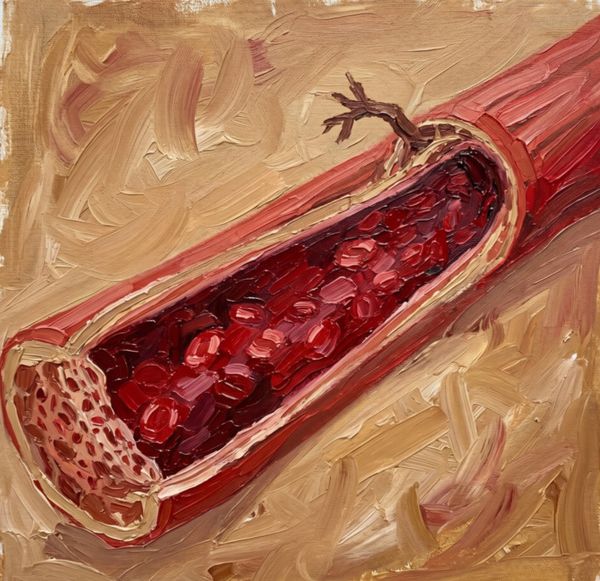
When I paint skin now, I no longer see a “problem area,” but a fortress wall: you can still see the marks from rain, sun, and small private wars, but the wall is still standing — exactly how dermatology texts describe a stressed but still working barrier.
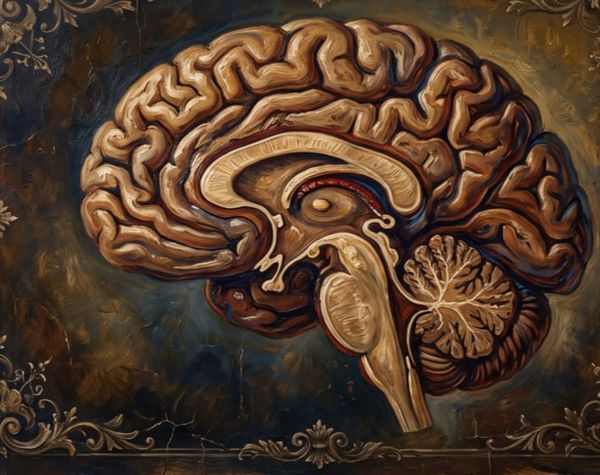
When I paint the belly, it’s no longer “flat or not,” but a negotiation room between the brain and the gut, where anxiety can raise its voice, but it’s still a conversation, not a life sentence — a visual version of those Johns Hopkins diagrams about the “second brain” in our gut.
All this science didn’t turn me into a doctor, but it gave me a crucial plot twist:
my body isn’t taking revenge on me — it’s translating my way of living into the language of symptoms.
Hope, for me, looks like this now:
if stress can break through onto my skin and into my belly, then tiny shifts in how I live can leave traces there too — something many of these same sources quietly hint at when they talk about gentler routines, better sleep, kinder schedules.
Not in the format of “tomorrow, a whole new life,” but as “one more millimeter of softness toward myself.”
When I look at my skin in the morning, I try to see not a checklist of flaws, but a map of what it has carried.
When I feel my stomach tighten from the news or an email from a doctor, I remember the brain–gut stories from Johns Hopkins and think:
“Okay, it’s not that I’m broken — it’s just two departments of one system speaking a bit louder. And I can talk with them, not go to war.”
If you’re reading this with a phone in your hand and a tense belly, here’s what I want you to know:
you’re not a strange person with “bad skin” and a “dramatic gut.”
You’re living in a body that honestly shows everything you’ve been through: the missing sleep, the missing pauses, the missing gentle light pointed your way.
You have the right to see your skin as an archive, not a defect,
your belly as a sensitive sensor, not an enemy,
and yourself as someone who can still add more tenderness than criticism to this entire canvas.
Listening to the body,
Lily Marigold