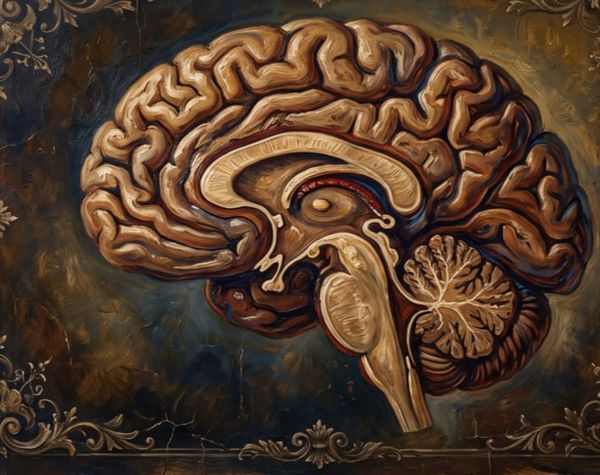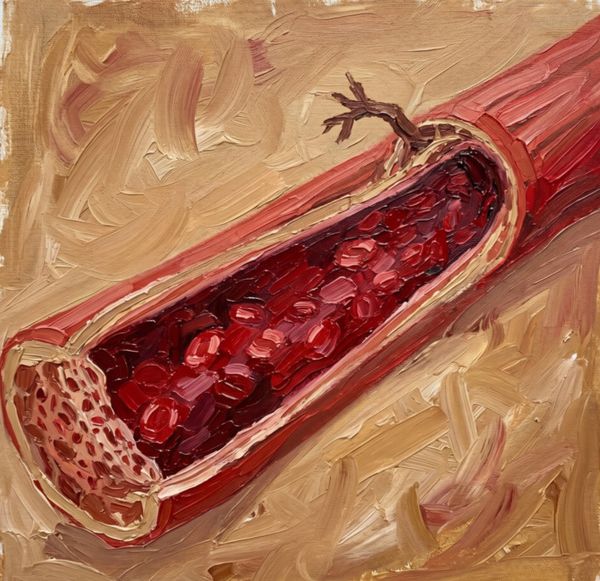
The half-second dip you keep calling nothing. It isn't.
It happens in the first three seconds after you stand up.
— Inside Body Art — |
Hi, this is Lily. |
You've had this moment. You stand up from a lawn chair on a hot afternoon, or step out of the car in your own driveway, and for half a second the world dips a degree. By the time your eyes catch up, it's already over. You called it nothing. It wasn't nothing. Dizziness is not a symptom. It's a conversation between three systems that briefly stopped hearing each other. Once you know who the three are, the whole thing stops looking like a mystery — and starts looking like a conversation you can eavesdrop on. And in July, when the pavement radiates heat and half of us are mildly dehydrated by four in the afternoon, they miss each other more often than usual. |
The three | |
Let me introduce them, quickly. The inner ear. Three fluid-filled loops behind each of your eardrums, plus two little sacs holding pebbles of calcium carbonate. Together they send your brain roughly 200 messages every second about which way is down. You have never once been aware of it — which is exactly what it feels like when it's working. The blood vessels. When you stand up, gravity pulls close to a pint of blood down into your legs. Your brain has about three seconds before it starts running low on oxygen. Your arteries have exactly that long to squeeze the pressure back up. The nervous system. Sits between the other two. Takes both reports, plus what your eyes see and what your feet feel, and casts one vote: you are upright; the room is not moving. When the three agree, you don't feel a thing. When they don't, you feel it as dizziness. Sometimes the vote is close. Sometimes one of them just stops answering. Here's what happens when it does. |
The vessels | |
Start with the vessels. This is the character with a deadline. You stand up — blood dumps into your legs — sensors in your neck fire off one command: squeeze. Arteries constrict, heart lifts, pressure returns to your head, usually within two seconds. That whole negotiation is called the baroreflex. It gets slower with age. In roughly one in five adults over 65, it doesn't get there in time. The clinical name is orthostatic hypotension. In everyday language, it's that half-second dip when you stand up — the one you might have been calling nothing. And in summer, it gets worse. Heat dilates your blood vessels. Sweating quietly pulls water out of your system. Both changes deepen the pressure-drop — a documented pattern the NIH's National Institute on Aging calls "heat syncope," made more likely by common heart medications like beta blockers. Here's the part almost nobody knows. A 2024 analysis in The Journals of Gerontology followed 448,374 adults and found that people with orthostatic hypotension had a meaningfully higher risk of heart attack, stroke and dementia later in life — and the earlier it started in life, the stronger the effect. The Dutch Rotterdam Study, tracking adults for 25 years, put the dementia risk about 20% higher in people with untreated OH. The mechanism isn't spooky. When your standing blood pressure runs chronically low, your brain briefly runs low on oxygen — a few seconds at a time, hundreds of times a year. Those small silences accumulate. The vessels aren't a supporting character. They're keeping score. |
The ear | |
Now the ear. That perfect 200-messages-per-second stream I described earlier — this is where it comes from. And this is where it goes wrong. When those calcium carbonate pebbles drift out of place (common after 50 — called BPPV), you get spinning vertigo when you roll over in bed. What surprised me most when I read about it: there's a ten-minute in-office fix, called the Epley maneuver. If your dizziness only appears when you turn your head, this is the first thing to ask about. When one ear gets inflamed after a virus — usually after a summer cold — you get one-sided imbalance for weeks. That's vestibular neuritis. And when both ears quietly lose function with age — no drama, no dizzy spell — you don't feel dizzy at all. You just feel like the ground isn't quite where it should be. That's the type nobody warned you about. |
The nervous system | |
The third character is the one that tries to make sense of the other two. Your brain doesn't experience "the ear" and "the vessels" as separate reports. It weighs them, cross-checks against what your eyes see and what your feet feel, and casts one vote. That vote is called sensory integration. It fails in one specific, well-studied way. After one bad episode — a bout of vertigo, one fainting spell, a virus in the ear — the integrator sometimes starts over-listening. Every faint signal from the ear gets amplified. The eyes become hypersensitive to visual motion. Grocery aisles feel wrong. Scrolling on a phone feels wrong. A crowded farmers' market on a summer afternoon feels wrong. Neck and shoulders quietly stiffen. And the dizziness becomes chronic — even after the original trigger healed months ago. The Bárány Society gave it a name in 2017: Persistent Postural-Perceptual Dizziness, or PPPD. It's now considered the single most common cause of chronic dizziness in outpatient neurology clinics. An April 2026 imaging study in Neural Plasticity (Kang et al., Wiley) watched what happens in the brain during PPPD. The connections between primary visual areas and the vestibular network were over-active. The coupling to the brain's own map of body-in-space was reduced. In plain English: the brain was trusting the eyes too much, and its own body too little. This is not "in your head" in the dismissive sense. It's exactly in your head — in the sense that the integrator stopped trusting his usual sources and started inventing motion where there wasn't any. |
|
The fourth character | |
There's a fourth character in this drama nobody puts on the poster: your medicine cabinet. Reviews across geriatric medicine estimate that roughly one case in four of dizziness in adults over 65 traces back to medication — usually a combination, not one culprit. The usual suspects: blood pressure drugs (especially when a second one gets added), benzodiazepines, sleep aids, some antidepressants, older antihistamines like Benadryl, and anticholinergic drugs used for bladder or heart conditions. Each one, alone, may have looked fine. It's the layering that does it. Which is why an annual medication review with your doctor isn't busywork. It's the single most productive dizziness conversation most people over 60 will ever have. And summer is a smart time to schedule it — heat and common medications (beta blockers, diuretics, some antidepressants) don't get along, and a review before the hottest months often catches something. |
♦ ♦ ♦ |
Speaking of medications — if you're curious how different classes of blood pressure drugs interact with dizziness (they don't all behave the same way), the sponsored piece below is a doctor walking through exactly that. I'm not your filter. Watch if it's useful. Skip past the divider if it isn't. |
One more thing | |
One more angle worth naming — because it's changed the whole map. Since 2020, a lot of previously well people started feeling dizzy on standing, and stayed that way. A January 2026 meta-analysis in Frontiers in Cardiovascular Medicine pulled together studies of people with long COVID and found that a significant share now live with some form of orthostatic intolerance: either the pressure-drop kind (OH) or a version called POTS, where the heart races on standing without the pressure falling. If you got a dizziness that never fully went away after a COVID infection — even a mild one — you are not imagining it, and you are not alone. The autonomic nervous system takes hits from viruses in ways we are only starting to map. |
What to notice | |
Five things to keep — not as a diagnosis, but as a vocabulary for the next conversation with your doctor.
None of this is a diagnosis. It's just a way of listening in on the conversation instead of calling it "a spell." |
♦ ♦ ♦ |
Until next week, Yours, Lily P.S. My mother had one of these "spells" this spring. Her doctor adjusted one of her blood pressure medications and added a simple rule: sit on the edge of the bed for 30 seconds before you stand up. That's it. The spells mostly stopped. Not medical advice — just what worked in one specific negotiation between one person's three systems. |
Sources this week |
Journal of Gerontology (2024) · Neural Plasticity (2026) · Frontiers in Cardiovascular Medicine (2026) · Rotterdam Study, PLoS Medicine (2016) · Bárány PPPD Criteria (2017) |