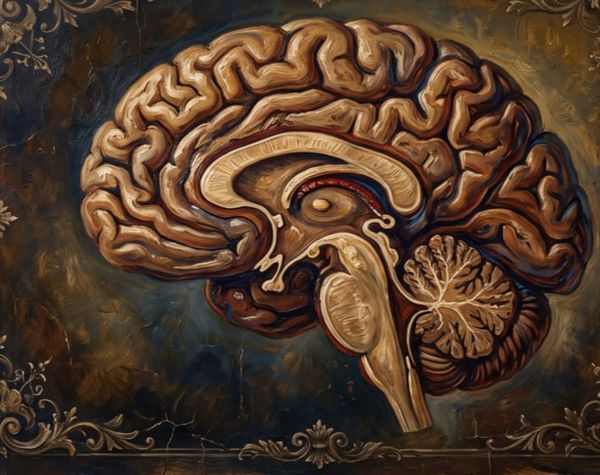
Your brain can still grow new connections. Most people don't know this.
There's a protein your neurons depend on. And you've probably never heard its name.

Hi, this is Lily.
There’s a moment most people recognize but rarely name.
You walk into a room and forget why you came.
A word sits right on the edge of your memory — and then vanishes.
You read the same paragraph twice and it doesn’t quite land.

Most people quietly file this under “getting older” and move on.
But your brain is not shrugging and giving up. It’s doing something much more specific — and, more importantly, much more changeable.
The protein your brain depends on — and quietly runs low on
BDNF — brain-derived neurotrophic factor — plays a critical role in neuronal survival and growth, serves as a neurotransmitter modulator, and participates in neuronal plasticity, which is essential for learning and memory.
Think of it as fertilizer for your neurons.
Not in a vague, metaphorical sense — in a specific, mechanical one. BDNF tells neurons to grow new connections, maintain existing ones, and survive longer. Without adequate levels, the brain’s ability to form new memories and retrieve existing ones becomes measurably slower.
Chronic stress and poor sleep are the two fastest ways to deplete BDNF — physically shrinking the hippocampus over time.
That last detail is worth sitting with.
The hippocampus — the region most responsible for converting short-term experience into long-term memory — literally changes in size based on what your BDNF levels are doing. This is not speculation. It’s one of the most replicated findings in neuroscience over the past two decades.
The brain is not a fixed structure that slowly deteriorates. It’s a living system — constantly pruning, rewiring, and rebuilding, based on the signals it receives.
What actually depletes it — and what raises it
This is where most articles go straight to supplement lists.
The research tells a more useful story.
Movement — specifically, the kind that gets your heart rate up.
Short bursts of high-intensity exercise — six one-minute intervals of cycling, for instance — raised circulating BDNF levels significantly in one study, while longer periods of moderate exercise did not produce the same effect. The mechanism involves lactate — a byproduct of intense effort that crosses the blood–brain barrier and directly signals BDNF production.
You don’t need a gym. You need, occasionally, to be slightly out of breath.
Sleep — specifically its architecture, not just its length.
BDNF is primarily synthesized during slow-wave sleep — the deep, restorative phase that shortens after 50. Sleep quality has a bidirectional protective relationship with BDNF — poor sleep depletes it, and lower BDNF further disrupts sleep. Breaking this cycle is one of the highest-leverage things you can do for cognitive health.
Food — specifically flavonoids and DHA.
Berries, leafy greens, and dark chocolate offer antioxidant protection and neurogenesis support — foods rich in flavonoids have been linked to improved memory and higher BDNF levels. DHA — the omega-3 found in fatty fish — is one of the most studied dietary compounds for BDNF support, with human evidence accumulating steadily over the past decade.
Chronic stress — the primary depleter.
When cortisol stays elevated over months and years, it suppresses BDNF gene expression directly. This is why stress isn’t just “uncomfortable” — it has a measurable, structural effect on the brain’s capacity to form and retain memories.
None of these are character flaws.
They are systems responding to inputs — which means the inputs can be changed.
The SuperAger question
Researchers studying people in their 70s and 80s with memory performance comparable to people 20–30 years younger — sometimes called SuperAgers — consistently find one common factor:
They never stopped learning hard things.
Not crossword puzzles. Not passive reading. Things that required genuine effort — a new language, a musical instrument, an unfamiliar skill. The kind of learning that feels slightly uncomfortable because it’s actually working.
BDNF expression is highly regulated and can lead to great variability in levels — even among healthy subjects. Some interventions are known to enhance this neurotrophin in both normal and pathological conditions.
The brain responds to demand.
Ask more of it — deliberately, consistently — and it builds more infrastructure to meet the ask.
About that 3‑minute sound
There’s growing interest in audio-based tools — specific sound frequencies, binaural beats, structured listening programs — as potential BDNF-adjacent interventions.
The claim that audio programs directly “activate BDNF” references a plausible hypothesis, not yet an established clinical outcome. The honest framing is: certain audio stimuli appear to influence brainwave states in ways that may support the conditions under which BDNF is more readily produced — particularly around focus, relaxation, and sleep onset.
Sponsored
Harvard brain scans showed 70-year-olds with brains that looked 20 years younger.
No fog. No “senior moments.”
These “SuperAgers” had sky-high BDNF—the memory protein tied to learning and recall.
Here’s the twist: a specific 3-minute sound frequency may help trigger it.

Want to hear it?
This week — one small ask of your brain
Pick something genuinely new to learn.
Not a task. Not a to-do. Something that requires your brain to build a connection it doesn’t already have.
A recipe in a cuisine you don’t know. Ten minutes of a language app. A piece of music you’ve never played. A route you’ve never walked.
The discomfort of not-yet-knowing is not a sign that it’s too hard.
It’s the sound of your neurons being asked to grow.
Listening to the body,
Lily Marigold