
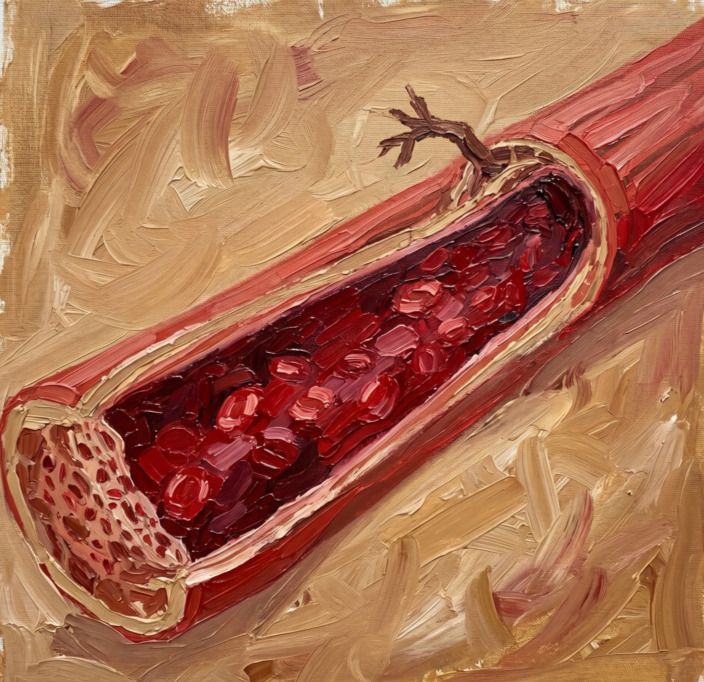
Your arteries have been writing notes you can't read
The lab number you've been watching for years tells half the story. Here's the other half.
Hi, this is Lily.
Maybe you know this scene.
You’re sitting in your doctor’s office. The annual physical results are in. Most numbers are “fine.” Your cholesterol is “borderline.” The doctor says: let’s watch it.
You go home with a sheet of paper and a few numbers — your LDL, your HDL, your triglycerides, a total.
But here’s what no one tells you.
The story written in your arteries is much longer than what fits on that sheet.
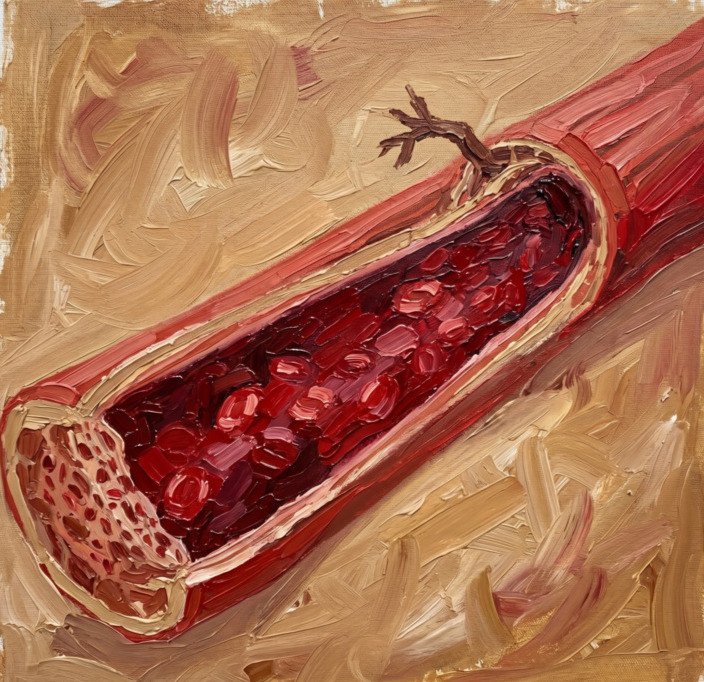
Your arteries are tissue, not numbers. |
The number on your panel is a summary. Not the whole story.
For decades, the standard cholesterol panel has been the lens American doctors use to look at your cardiovascular risk. LDL — the “bad” cholesterol — gets most of the attention.
But LDL on a lab report measures the amount of cholesterol being carried inside LDL particles. Not the number of those particles.
Two people can walk in with the same LDL number — and have completely different arterial pictures. One has a small number of large, “fluffy” particles. The other has a very large number of small, dense particles. The amount of cholesterol is the same on paper. The number of trucks rolling through their arteries is not.
And it’s the particles — not the cholesterol they carry — that slip into artery walls and start building plaque.
|
There’s a more accurate number. And most doctors don’t order it.It’s called Apolipoprotein B. ApoB for short. Here’s why it matters: every atherogenic particle in your blood — every LDL, every VLDL, every IDL — has exactly one ApoB protein attached. One per particle. Always. So when you measure ApoB, you’re not measuring how much cholesterol is being carried around. You’re counting the particles themselves. Cleveland Clinic puts it plainly: “Researchers have found that measuring Apo B may predict heart and blood vessel disease risk better than a lipid panel test.” A 2025 systematic review in the Journal of Clinical Lipidology looked at every available comparison study. In nine out of nine, ApoB was superior to LDL cholesterol as a predictor of cardiovascular disease. The European Society of Cardiology has been recommending ApoB over LDL for years. Many American doctors still order only the standard panel. |
Why this matters more after 50.Before 50, the standard panel does a reasonable job for most people. After 50, things shift quietly. Your liver clears LDL particles a little less efficiently. Triglyceride-rich particles become more common, especially with changes around the middle. Insulin sensitivity drops for many people, which changes how the body handles fat. Small dense LDL particles — the kind that slip into artery walls most easily — increase. What changes practically: your LDL on the lab sheet can look fine, while your ApoB tells a different story. Cardiologists call this “discordance.” It’s common in people with even modest metabolic shifts — the kind that often arrive in our 50s and 60s without fanfare. |
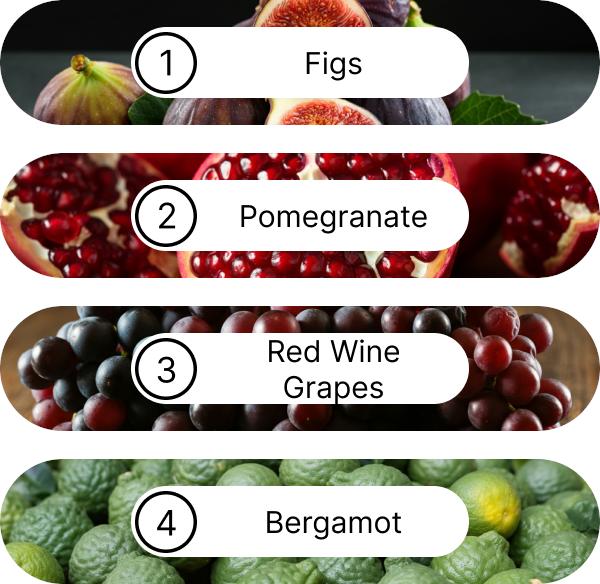
What actually moves the needleThe good news: arteries are responsive. They don’t just record damage. They respond to what you do. A few of the levers with decades of evidence behind them: Soluble fiber.Mayo Clinic notes that 5 to 10 grams of soluble fiber a day decreases LDL cholesterol. Found in oats, legumes, certain fruits and vegetables. Boring? Yes. Effective? Also yes. Plant sterols and stanols. Naturally occurring compounds in many plant foods. Mayo notes that adding 2 grams per day can lower LDL by 5% to 15%. Omega-3s from fatty fish lower triglycerides. A Mediterranean-pattern diet — heavy on plant foods, olive oil, fish, with less ultra-processed food — consistently shows benefits. The PREDIMED trial found people following it had roughly 30% lower risk of major cardiovascular events. Researchers keep coming back to specific plant foods, again and again. Not because they’re exotic — because they contain particular compounds (polyphenols, certain fibers, specific micronutrients) that interact with how the body processes cholesterol particles. A reader wrote me last week asking which fruits keep showing up in this research. I’ve seen a few breakdowns floating around. A writer I sometimes read, Dr. K, just put together a quick quiz about one specific fruit that comes up more often than people realize. Worth a minute before you scroll on — see if you can guess the answer. |
Sponsored |
|
Whatever you decide about specific foods, the bigger picture is this: Your arteries don’t keep secrets. They keep records — quiet, slow, accumulating. Every meal, every late night, every long stressful year is in there somewhere. They’ll absorb what comes next, too. That’s not a reason for panic. It’s a reason to keep paying attention — and maybe to ask one more question at your next appointment: “Have you ever measured my ApoB?” It’s a simple blood test. No fasting required. Around $50–$80 at most independent labs in the U.S. Not part of the standard panel — but orderable from any of them. Until you name it, no one will. Sometimes the most powerful thing you can do for your body is start reading the notes it’s been writing all along. Listening to the body, Lily Marigold |
Sources: Cleveland Clinic · Journal of Clinical Lipidology, 2025 · Mayo Clinic |