I barely touched the table. Now there's a bruise the size of a plum.
It's not clumsiness. It's a map of what's happening just under your skin.

Hi, this is Lily.
You bumped into the kitchen counter. Barely. The kind of contact that, ten years ago, wouldn't have left a mark — wouldn't even have registered as "a bump."
Two days later, there's a bruise the size of a plum.
You don't remember it forming. There was no sharp pain, no moment of "ouch." Just — there it is. Purple, then green, then a strange yellowish-brown that lingers for what feels like weeks.
If this sounds familiar, you're not imagining it, and you're not suddenly clumsy.
Something underneath your skin has quietly changed — and once you understand what, the whole thing stops feeling like a mystery.

Your skin used to have a cushion. It's thinner now.
Picture your skin in three layers, like a sandwich.
The top layer — thin, renews itself constantly.
The middle layer — full of collagen, elastic, structural.
And underneath that, a layer of fat that acts like packing foam, absorbing small impacts before they ever reach the blood vessels.
As we age, skin naturally becomes thinner and loses collagen — the protein that gives it elasticity and structure. The fatty cushioning layer underneath also diminishes, leaving blood vessels closer to the surface and more exposed.
That's the whole story, in a sense. The packing foam gets thinner. The vessels sit closer to the surface. And a bump that used to be absorbed now reaches places it didn't before.
Your skin isn't failing. It's just lost some of its padding — and the blood vessels underneath are feeling things they used to be protected from.
Why the bruise looks darker than it used to — and stays longer
This part surprises people.
Because the skin is thinner, bruises now sit closer to the surface and appear darker and more defined than they would have at 30. Same amount of bleeding under the skin — but less tissue between it and your eyes, so it looks more dramatic.
And then there's the lingering part.
The lymphatic system — which clears away the breakdown products of blood — also works more slowly with age. This means it takes longer to remove the pigments that cause a bruise's color changes, so bruises that once faded in days now take weeks.
So: same bump, darker mark, slower fade. Not three separate problems. One underlying shift, showing up in three ways.
The detail almost nobody mentions: collagen needs raw material
Here's where it gets genuinely useful.
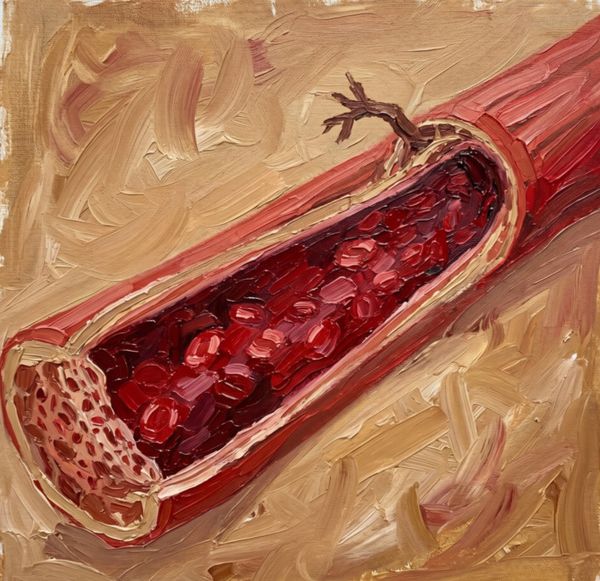
Collagen is essential for keeping blood vessel walls strong — and your body needs vitamin C to produce it. When vitamin C levels drop too low, connective tissue can't be properly maintained, and capillaries become more fragile and prone to leaking.
Most people over 50 aren't deficient in vitamin C in the dramatic, scurvy-era sense. But "not deficient" and "fully stocked" are different things — and collagen production is one of the first processes to slow down when supply runs a little short.
Think of it like a construction crew that's been told to "make do" with slightly less material for years. The walls still get built. They're just a little less robust than they could be.
One thing worth checking — quietly, without alarm
Frequent bruising can sometimes be connected to certain medications — blood thinners, regular NSAID use like ibuprofen or aspirin, and even some supplements such as fish oil, vitamin E, or ginkgo biloba can make bruising more likely.
This isn't a reason to panic, and it's not a reason to stop anything on your own. It's simply useful information to have ready — especially if the bruising feels like it's increased noticeably over the past year, or if it's showing up in places that don't get bumped (your torso, for instance, rather than your arms and shins).
That kind of detail is exactly the sort of thing worth mentioning at your next routine visit — not urgently, just on the list.
When it comes to bruising, what's changed for you lately?A quick check-in |
What actually helps — and it's not complicated
Feed the collagen.
Citrus, berries, bell peppers, leafy greens — vitamin C—rich foods support the structural protein that keeps capillary walls intact. Not a megadose. Just consistent presence on the plate.
Protect what's already thin.
Daily sunscreen matters more than most people think — UV light breaks down collagen and accelerates the thinning that makes blood vessels more vulnerable in the first place. This isn't about wrinkles. It's about the literal structural integrity of your skin.
Give bruises grace, not haste.
Once a bruise has formed, there isn't much to speed it along — but elevating the area and applying ice early can help reduce how large it becomes. The rest is just time, and a slower lymphatic system asking for patience.
Notice the pattern, not the single bruise.
One bruise on your shin from the coffee table is nothing. A new pattern — more frequent, larger, or in unusual places — is simply data. Data worth mentioning, not worrying over.
A bruise is not a failure of your body. It's a small, visible record of how thin the cushion has become — and a reminder that the cushion can still be supported.
One last thing.
There's something almost touching about a bruise you don't remember getting.
It means you moved through your day — reached for something, leaned against a counter, hugged someone a little too enthusiastically — without your body stopping you to register pain.
The mark that shows up two days later isn't a warning.
It's just your skin, a little less padded than it once was, quietly keeping a record of an ordinary day.
Listening to the body, Lily Marigold
Sources 1.Skin Care and Aging — National Institute on Aging (NIH) Updated January 2026 2.Easy bruising: Why does it happen? — Mayo Clinic Updated May 2025 3.Why do I bruise so easily? — Harvard Health Publishing (Harvard Medical School) Howard E. LeWine, MD · June 2021 4.Vitamin C: Fact Sheet for Consumers — NIH Office of Dietary Supplements National Institutes of Health 5.Recent advances in dermal fibroblast senescence and skin aging — Frontiers in Pharmacology Peer-reviewed · May 2025 |