Why Your “Random” Stomach Pain Isn’t Random at All
If your belly keeps saying “ouch” with no clear reason, this one maps the reasons out.

Hi, this is Lily.🌼
With this piece, I don’t want to give your gut a pep talk.
I want you to walk away with three tangible things:
- less shame about a “dramatic gut” — more understanding of why it reacts;
- a clearer link between coffee, choppy snacks, stress and your symptoms;
- 2–3 very small steps you can test today, without signing up for a new lifetime diet.
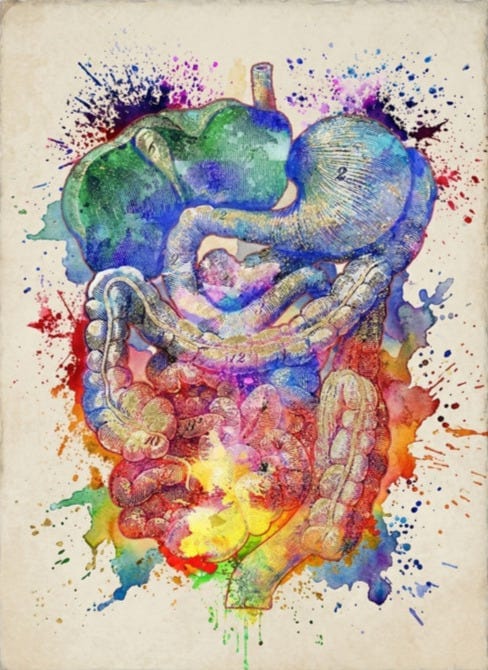
Morning. Gut and coffee instead of breakfast
Alarm. First move: not to the kitchen, but to the coffee maker.
Black coffee rushes in, and the gut stays politely quiet:
“Okay. So today we’re doing caffeine without fuel again. I’ll adapt.”
In recent pieces and reels from U.S. gastroenterologists and dietitians, you see the same thing:
for a lot of adults, “breakfast” = coffee, not food. The gut gets a wake‑up signal, but without protein, fiber and water, it’s more like a nervous jolt than a stable start.
Minimum step (not perfection):
- a glass of water before coffee;
- something small but real (yogurt, toast with anything, a handful of nuts) at least 3 mornings a week.
That alone can change how fast “acid and jitters” show up in your stomach instead of a steady, ordinary hunger.
Midday. Gut and on‑the‑run snacks
Lunch slides between back‑to‑back calls.
You eat standing, over your laptop, scrolling emails or headlines.
In that scene, the gut is quietly saying:
“I’m not just chewing your food. I’m chewing your stress, your deadlines, and last night’s argument at the same time.”
Clinics like Johns Hopkins and Harvard Health describe the brain–gut axis in very plain language:
your brain and digestive system are on an open line all day; stress can slow or speed gut motility and turn the volume up on pain and bloating.
When you eat in “one more email, one more Slack” mode, your body is technically feeding you, but your nervous system behaves like you’re still standing in a hospital hallway.
Minimum step:
- one meal a day without a screen (not all of them — just one), even if it’s only 10–15 minutes;
- and before the first bite, three slower breaths, as if you’re turning the room’s volume down a notch.
Research on stress and digestion shows that even small “calm windows” around meals can noticeably ease symptoms for many people with sensitive guts.
Evening. Gut and the fight / bad email
Dinner’s on the plate; on the screen, an aggressive message or a cold work email.
Your shoulders creep up, your jaw tightens, and the gut responds honestly:
“You’re not just feeding me dinner. You’re serving me a cocktail of cortisol and resentment.
I can handle it, but I’ll probably charge a fee: a cramp, bloat, or that famous ‘rock in the stomach.’”
Reviews on stress, diet and the microbiome from NIH and large endocrine journals keep showing the same pattern:
with high chronic stress, people more often report abdominal pain, irregular bowels and appetite changes — even without a big, dramatic diagnosis.
Minimum step:
- if you can, don’t stack dinner directly on top of the most explosive email or text; give it even 10–15 minutes’ distance;
- if you can’t avoid it, offer yourself a warm drink and a few minutes of quiet after eating instead of jumping straight back into the thread.
It won’t fix the whole life story, but it does create a tiny separation between “emotional storm” and “digestion in progress.”
Night. The gut’s daily report
When the screens finally go dark, your gut quietly writes the most honest summary of your day:
- where today was true hunger vs. anxiety dressed up as hunger;
- when you actually ate vs. when you just grabbed something between obligations;
- which moments tightened your belly not because of food, but because of news, silence, or waiting on results.
Modern pieces on the brain–gut axis and “gut‑aware” eating tend to agree on one thing:
the gut is not a drama queen; it’s a very literal reporter of how you live.
Its “overreactions” are often not character flaws, but its way of flagging the exact places where your rhythm, your stress, and your meals are colliding.
What you can actually take from this “day with the gut”
- Your symptoms are not “I’m weird”; they’re a normal part of the brain–gut axis that Harvard, Stanford, Cleveland Clinic and others keep writing about.
- Even if you never overhaul your entire diet, three small moves are already working with you, not against you:
- water + something to eat with or before coffee a few mornings a week;
- one screen‑free meal a day;
- not layering dinner directly on top of the most stressful email when you have any choice.
And if you’d like to keep going, you can try your own “one day with an organ”:
It doesn’t have to be the gut — it could be your heart, lungs, or nervous system.
A few times in a day, just ask yourself:
“What would my [organ] say about what I’m doing right now?”
Not to find more faults, but to finally let your body have a voice in a day where it’s usually treated as background.
Listening to the body,
Lily Marigold
Feeling off lately? It could be your hormones.
Allara helps women understand the root cause of their hormonal or metabolic symptoms with a comprehensive care team that combines expert medical and nutrition guidance. Whether you're managing PCOS, fertility challenges, perimenopause, thyroid conditions, or unexplained symptoms, you'll get a personalized care plan backed by advanced diagnostic testing and ongoing support. This isn't about quick fixes. It's about getting clarity and feeling like yourself again, with care that's accessible virtually and covered by insurance.