If Your Organs Kept a Secret Diary Tonight
For when your gut, skin and pulse feel dramatic, but it’s really just physiology with a good memory.

Hi, this is Lily Marigold.
Imagine that at night you’re scrolling not the news, but an inner sketchbook — how your day looks inside your organs.
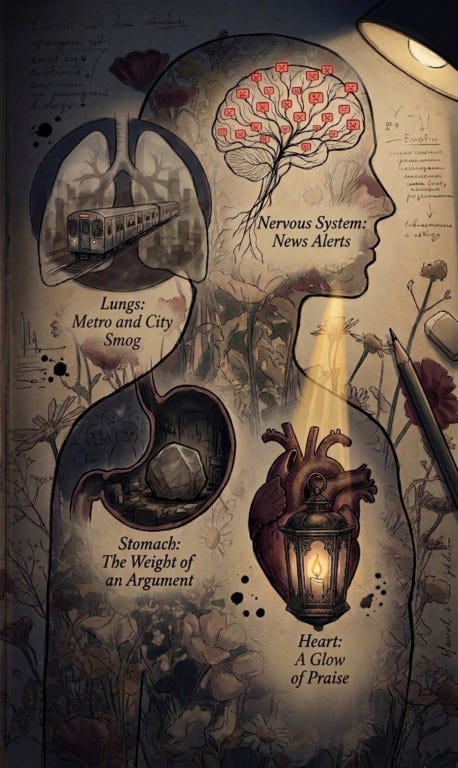
Lungs after the subway
Rush hour, packed car, heavy air. The lungs are working like a filter, not a backdrop: every inhale adds another layer of city dust, every exhale leaves a trace of “I’m tired” even if you “just sat.”
Researchers have shown that daily commutes in enclosed transit with fine particles and pollution add real load to healthy adults’ lungs.
Tiny benefit: if you can, take a few deeper breaths outside after the subway, or walk 5–10 minutes before sitting back down at a screen. It’s not a detox, just a small reset for your lungs.
Nerves after the news
Your body is in bed, but your nerves are working night shift in a control room: every headline is another red light, “urgent, don’t look away.” Falling asleep feels hard not because of “weak will,” but because your sympathetic system is still in fight‑or‑flight.
Tiny benefit: putting a soft boundary on heavy news 30–60 minutes before bed isn’t denial; it’s a way to give your nervous system a chance to switch into rest‑and‑digest. Even one such evening a week changes how falling asleep feels.
Stomach after a fight
The argument is over, but your stomach is still playing the final scene: tightness, “a rock,” no appetite even if you barely ate all day. For the brain–gut axis, emotional conflict is a real stressor: it changes gut motility and makes the system more sensitive to pain and discomfort.
Tiny benefit: noticing the link “fight → stomach” and dropping the “my body is weird” script. A warm drink, slower breathing, or simply a pause before eating after a conflict is less a ritual and more basic protection for digestion.
Heart after praise
One sincere “this really helped me” — and the heart speeds up, but differently than with fear. It’s not a siren, it’s a short burst of music. For a few seconds, breathing feels easier, shoulders drop, the inner narrator goes from “I’m failing” to “maybe this matters.”
Neuroscience work on gratitude and positive feedback shows that genuine recognition can activate reward circuits and gently engage the parasympathetic system — the one that calms and lets the heart step out of constant overtime.
Tiny benefit: treating even small bits of praise (from others or from yourself) as data, not embarrassment. It gives your heart at least a few moments of “this worked” instead of only “what’s wrong now,” and that’s part of nervous‑system care too.

What’s in it for you
- You start seeing symptoms not as “I’m broken,” but as logical reactions of real organs to a real day.
- You get 1–2 very simple levers for lungs, nerves, stomach, and heart — no 30‑point perfect‑habit lists.
- Next time your gut knots after a fight or your heart races after the news, you’re more likely to think, “Oh, that’s my inner sketchbook,” instead of “I’m just being strange” — and that shift alone is a quieter way of taking care of yourself.
Listening to the body,
Lily Marigold