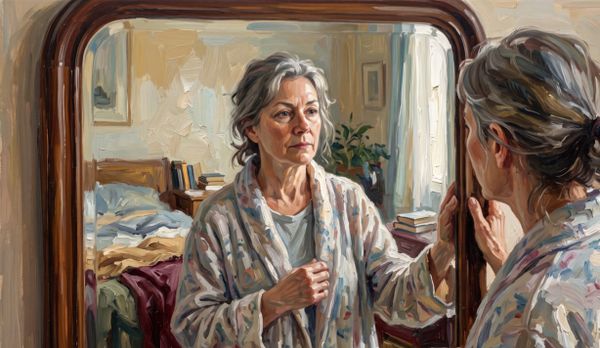
When your heart wakes you up at 2:37 a.m.
What to do in those five minutes between fear and “I’m okay”

Hi, it’s Lily.
Tonight I want to sit with a scene that quietly belongs to midlife.
Not our twenties, not a TV drama — the real, ordinary 40+ years.
You wake up at 2:37 a.m.
The house is doing that perfect middle‑of‑the‑night stillness — fridge humming, dog snoring, the street outside pretending nothing ever happens after midnight.
And there’s exactly one thing that refuses to go along with this picture: your heart, suddenly deciding to play solo.
Not “soft jazz in the background,” but an internal drummer who went into a full set without asking.
Your brain pulls out the old script:
“This is it. A heart attack. If I call 911, I’m overreacting. If I don’t… what if I’m wrong?”
Life after 40 often looks exactly like this: on the outside everything is quiet, but the loudest events happen in your chest and in your head.
When this is not a “just breathe and wait” night
We’re adults, not inspirational Reels.
There are things you don’t play “I’ll just wait a bit” with.
If your nighttime heart pounding comes with any of this:
- strong, squeezing, or burning chest pain that doesn’t let up;
- real trouble breathing, like you can’t get enough air;
- dizziness, feeling like you’re about to faint, or actually blacking out;
- cold sweat, sudden weakness, nausea;
- pain or pressure spreading into your arm, jaw, back, neck, or upper stomach;
you’re in 911 / ER territory, not “one more YouTube meditation.”
In that moment you are not “being dramatic.”
You are a human with a heart, choosing to give it a chance.
When there are no clear red flags, but it’s scary
There’s another script.
No crushing pain. You can breathe.
But your heart is doing its night set and your mind is running the trailer of the worst possible endings.
This is where those same 5 minutes start — the ones where you actually have something to do besides scroll.
1. An honest safety check
Not heroics, not self‑diagnosis. Just a few grounded questions:
- Do I have strong, heavy, or squeezing chest pain?
- Is it truly hard to breathe, like I can’t get air in?
- Is the room spinning, going dark, or do I feel like I might pass out?
- Is there sudden weakness, cold sweat, or nausea?
- Is there pain or pressure going into my arm, jaw, back, neck, or upper stomach?
If the answer to any of these is “yes” and it’s not easing — stop reading, pick up the phone, and let the adults dial 911.
If not — we move into the “make it to morning without gaslighting yourself” plan.
2. Sit your body down
I like to think of this as giving yourself “front row seats” again.
- Sit up on the bed or in a chair.
- Put your feet flat on the floor.
- Feel your back supported by something solid — headboard, wall, chair.
- Place your hand on your chest or your belly. Not to “control” anything, but to literally feel: “I am here, in a body, not only in my thoughts.”
Many of us, in moments like this, are half‑hovering between the bed and the ceiling — physically and mentally.
The body likes to know exactly where it stands.
3. Give your nervous system a small remote
Not a magic trick that “normalizes your EKG in 30 seconds.”
A small, boring, but workable ritual.
- inhale through your nose for a slow count of 4;
- exhale through your mouth for a slow count of 6;
- repeat 10–15 times.
On each exhale, not “calm down right now,” but an invitation:
“I’m giving my body a chance to turn the volume down one notch.”
Not switching the alarm off entirely, just taking the inner caps lock off.

4. A tiny report for Future You (and your doctor)
When the wave has rolled back even a little, it’s time for the least dramatic gesture of the night.
Write down three things:
- the approximate time: “2:37 a.m.”;
- how long it lasted before it clearly eased (seconds, minutes, “more than 10 minutes”);
- what was happening 1–2 hours before:
- coffee, alcohol, heavy or very late dinner;
- workout or absolutely no movement;
- a fight, bad news, doomscrolling;
- new or changed medications or supplements.
This is not a “panic diary” and not content for social media.
It’s a short report for the doctor you can later tell:
“I’ve had a few nights like this. Here’s what they look like.”
How to talk to your doctor when you’re not 25 anymore
In the morning it’s very tempting to pretend the night scene never happened.
“I overreacted. It was just nerves. My doctor has real problems to deal with.”
I’m offering a different script — calm but grown‑up:
“I’ve had a few episodes of waking up at night with a fast heartbeat.
Here are the times, how long they lasted, and what was going on before.
What do we need to rule out in my case? Do I need any tests?”
That’s not the voice of panic.
It’s the voice of a midlife human who figured out:
“I don’t have to either heroically stay silent or dramatically scream.
I can just bring my facts and ask clear questions.”
Your tiny night checklist from Lily
You can save this, or send it to the friend who secretly lives on “quiet heart chaos” right now:
In case you wake up to your heartbeat at 2:37 a.m.
- Quick safety check.
Strong chest pressure, real trouble breathing, feeling like you might pass out, cold sweat, pain going into arm/jaw/back?
If yes and it’s not easing, this is 911 / ER, not “wait and see”. - Sit your body down.
Feet on the floor, back against something solid, one hand on your chest or belly.
Remind yourself: “I’m here, in my body, not just in my thoughts.” - Breathe with a longer exhale.
Inhale through your nose for 4, exhale through your mouth for 6.
Do 10–15 rounds. Each exhale is you gently turning the volume down, not forcing instant calm. - Leave a note for Future You (and your doctor).
Jot down: time, how long it lasted, what was happening 1–2 hours before (coffee, alcohol, heavy dinner, stress, new meds).
Bring this to your appointment and say:
“I’ve had a few nights like this. What do we need to rule out?”
This is not about learning to “never be afraid.”
It’s about something else:
about your right to have a night that scares you, a heart that sometimes plays solo,
and a plan where you are not the victim, not the actress, and not the doctor —
but an adult who notices, writes it down, and speaks it out loud.
Listening to the body,
Lily Marigold
Needle-Free GLP-1 Oral Drops Starting at $147
Many people think weight loss is only about willpower. But appetite signals often make it harder than it seems.
GLP-1 treatments help regulate those signals. Some users say the first noticeable change is simple: their jeans start fitting comfortably again.