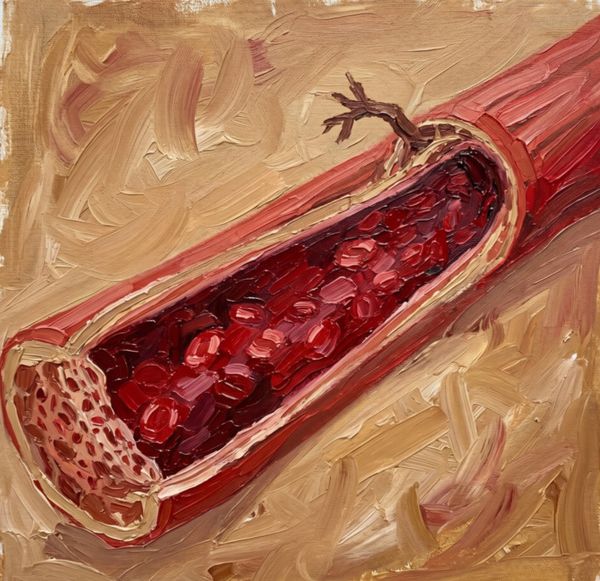
You're not cold. Your warmth just isn't reaching you.

Hi, this is Lily.
There’s a very specific feeling:
you walk into a room — everyone is fine.
You’re not.
It’s almost like you’ve stepped into a slightly different climate — one that exists just for you.
You sit there in a sweater, tucking your hands into your sleeves, reaching for something warm to drink,
and wondering: “Is this just me?”
From what I see in medical research and in real life,
this is almost never about personality.
It’s about how your body produces heat — and how it moves it around.
Sometimes the problem isn’t that there isn’t enough warmth.
It’s that it’s not reaching the places where you feel it.

What’s actually happening in your body
Feeling cold is not just about the air around you.
It’s about physiology: blood flow, hormones, and muscle.
1. Blood flow: where your heat goes
Heat in your body travels with your blood — like a heating system.
When the small vessels in your hands and feet narrow,
your body is essentially turning down the “radiators” in those areas and keeping warmth closer to your core.
So you get:
- cold fingers and toes
- a relatively warm center
- the feeling of “I’m cold all over”
This isn’t a malfunction.
It’s your body saying: “protect first, comfort later.”
2. Thyroid: your internal thermostat
Your thyroid works like an internal thermostat.
You don’t feel it directly, but it sets the pace for how much energy — and heat — your body produces.
When that pace slows down, even slightly,
it can feel like your whole system is running in “energy‑saving mode”:
- you feel colder than others
- it takes longer to warm up
- you rarely get to that sense of “I’m truly warm”
It’s a quiet shift.
That’s why it’s easy to dismiss it as “I’m just someone who gets cold.”
3. Muscle: your built‑in heater
Your muscles are your internal heater.
Not loud, not obvious — but constant.
They generate heat even when you’re at rest.
When you have less muscle activity,
that heater runs a little lower.
And your body can start to feel like a house that’s technically heated —
just never quite warm enough anywhere.
Three very familiar patterns
See if any of these feel like you.
- “Cold hands, warm room.”
Everyone else is comfortable — your fingers are cold.
The warmth exists, just not where you feel it. - “I’m always layering.”
You’re always wearing one more layer than everyone else.
As if you’re living in a slightly cooler version of the same room. - “I warm up slowly — and cool down fast.”
It takes time to get warm, but not much to feel cold again.
Like a cup of tea that cools before you’ve finished it.
A one‑week experiment: warming from the inside
This isn’t about “just dealing with it” or adding another blanket.
It’s about helping your body move heat more effectively.
Move your body to move your heat
Your body warms itself through movement.
When you move, two things happen at once:
your muscles generate heat, and your blood carries that heat outward — to your hands, your feet, your skin.
Even very small movements are enough:
- a minute of walking around the room
- a few slow squats or sit‑to‑stands from a chair
- rising up on your toes several times
- opening and closing your hands, circling your wrists
This is not “exercise.”
It’s your simplest built‑in switch that says:
“send warmth where it’s needed.”
Add “heat moments” earlier
Warmth is easier to maintain than to rebuild.
Like a house — once it’s fully cooled, it takes more effort to heat it again.
So instead of waiting until you’re already shivering:
- add a layer a little earlier
- wrap your hands around a warm mug before your fingers go numb
- build small warm pauses into your day, not just “emergency” fixes at night
You’re helping your body stay in a comfortable zone, rather than constantly chasing it.
A small but important note
If feeling cold is new, constant, and comes with other changes
(like unusual fatigue, weight shifts, or changes in skin and hair),
it’s worth asking your doctor to check your thyroid and basics like blood counts.
Not out of fear.
The same way you’d check a thermostat if the house suddenly stopped holding heat.
A small check‑in
Ask yourself:
“When today did I feel genuinely warm?”
And notice what was there:
movement, sunlight, food, company, a warm cup in your hands.
These aren’t small things.
They’re clues.
And one more thing.
Warmth is not just about temperature.
It’s about how it moves through you.
Sometimes it’s there — just staying closer to your center,
not quite reaching your hands, your feet, your skin.
And what your body is really saying is:
“I’m not completely cold.
I’m just not distributing the warmth very well.”
You don’t need to overhaul your life.
You just need to help that warmth find its way —
into your fingers, your feet, the places where you actually feel it.
Small movements.
Small habits.
And a little more attention to how your body quietly tries to keep you warm.
Listening to the body,
Lily Marigold
You’re 28 days away from firmer, glowier skin.

Aramore’s MIT & Harvard co-founders developed a special complex to help boost back skin’s NAD+, the molecule that controls how we age. Best part: you’ll see results in just one skin cycle, or 28 days.
Start your skin transformation with 20% off. Use code NEWSLETTER20.