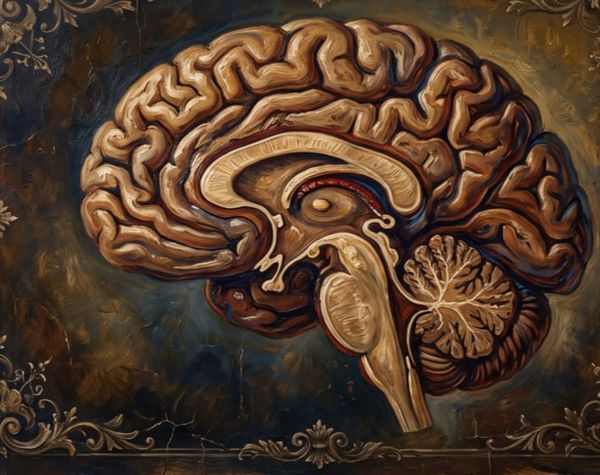
Your body never forgot. You just stopped listening.
That tight jaw? It remembers more than you think

Your body is not just “carrying” you.
It’s keeping score — of every kindness, every rush, every sharp word you swallow instead of saying it out loud. And this memory doesn’t live in a journal; it lives in your muscles, your breath, your skin, your pulse.
The body as a quiet archivist
Hi, this is Lily.
Maybe you think of yourself like this: “My memory is so‑so, I forget half of what happens anyway.”
Your body disagrees. It remembers:
- the day you “held it together” and couldn’t unclench your jaw that evening;
- the time someone said something that really hurt, and you smiled instead — and your shoulder has never quite softened since;
- every small act of care — a warm blanket, a hand on your back, a cup of tea when you were on empty.
More and more, psychologists and doctors are paying attention to something very simple: the way the body remembers. Not as stories in your head, but as tight shoulders, shallow breathing, a clenched jaw, or a stomach that never fully relaxes.
A lot of what we never put into words quietly settles into the body instead.
How your body remembers hurt
Not all pain passes through words. Some of it stays in the body.
When something painful happens and you can’t respond, can’t leave, can’t even talk it through, your nervous system does the only thing it knows how to do: it finishes the scene through your body.
Your muscles tighten, your breath goes shallow, your heart speeds up — and if this happens often enough, your body starts to treat that pattern as “normal.”
- Unspoken resentment can settle into a neck and shoulders that never really drop.
- Fear of conflict can live in a stomach that tightens every time “that” number calls.
- Shame can live in rounded shoulders, small breaths, a constant wish to be smaller, less noticeable.
You may have “forgotten” the exact words or scene. Your body has not.
For your body, it isn’t a story; it’s a danger signal that never really ended in “now I’m safe again.”
When something is too much and you can’t say anything, can’t leave, can’t even cry properly, your body does what it can: it tenses up to get you through.
If that happens often, your body gets used to ending difficult moments with “tighten and get small”, and that pattern can stay in your muscles and breath for years.
Later, when something even slightly similar shows up — a tone of voice, a smell, a familiar situation — your body quietly goes back into that same old protective shape.
You think: “Why am I reacting like this again?”
Your body answers: “I’m doing the only thing that once helped you survive this.”

How your body remembers kindness
The good news: your body remembers relief just as well.
Every time:
- someone hugs you and you let yourself lean in, even a little;
- you tuck a blanket around yourself when you’re cold, instead of “just putting up with it”;
- you take a deeper breath and notice, “right now, in this room, nothing terrible is happening,” —
your nervous system makes a tiny mark: “this is what ‘I’m allowed to soften’ feels like.”
Over time, that becomes memory too:
- A certain smell (the cream you use at night) — and your body starts to calm down almost by itself.
- A familiar gesture (a hand over your heart, a palm on your belly) — and your breath deepens, even without any “correct technique.”
- A particular position (knees drawn up, your back supported) — and your mind lets go of a bit of control.
From your body’s point of view, this is very simple: what you repeat becomes a path.
If the path “tighten and endure” is very well‑worn, but day after day you add small gestures of care, your body slowly builds a second path: “I am allowed to be treated gently.”
A one‑week experiment with your body’s memory
I’m not going to tell you to “rewrite all your trauma.”
But I will offer seven days of small, quiet gestures your body can remember as acts of kindness.
Choose one of these practices. Not all three. One.
1. A hand on your heart after every slight
Each time something stings — a sharp comment, an indifferent look, “you’re overreacting” — let your body register it.
Your step:
- pause for a few seconds;
- place your palm on your chest;
- take 5 slow exhales, as if each exhale is moving the situation a little further away from your heart.
You don’t have to breathe “correctly.” What matters is this: instead of running from the feeling, you give your body a clear signal — “I’m here with you, I see that this hurts.”
For your body, it’s not only what happened that matters, but also whether there was even one warm, supportive response — even if it’s just your own hand on your heart.
2. A daily gesture of unhurried kindness
Once a day, do something slow and gentle just for your body, not for productivity.
For example:
- put cream on your hands, not “on the run,” but with attention to each finger;
- drink a glass of water slowly, feeling how it moves through you;
- sit for 2 minutes with your arms wrapped around your shoulders, the way you’d hold someone you love.
These are tiny things, but they create a new kind of memory:
“I’m not only something to be used and pushed — I’m also someone to be treated softly.”
The more two things happen together, the more your brain links them.
If tiredness always comes with “just push through”, your body learns that. If tiredness more and more often comes with a small act of care, your body can slowly learn that too.
3. An evening body “inventory”
Before bed, take a quick look at where your day is living in your body.
Ask yourself:
- Where is the tension strongest right now: jaw, neck, stomach, lower back?
- What have I been carrying today — anger, fatigue, anxiety, shame?
- Did I offer myself even one small gesture of kindness today?
Then add one move:
take the muscle you’ve chosen (for example, your shoulders), gently tense it on purpose for a moment, and then let go.
For your body this is a very down‑to‑earth signal: “this tension isn’t just happening to me, I can turn it up and down at least a little.”
Your body often releases more easily what it has first been allowed to hold consciously, even for a second.
Old hurts, new endings
Old stories can’t always be rewritten in words.
But your body can be taught new endings.
Once:
- someone cut you off mid‑sentence, and you pulled your shoulders up and went quiet;
- someone shouted at you, and your belly pulled in like a child’s;
- you “kept it together” at a funeral or in a hospital, and then couldn’t quite breathe properly for weeks.
Back then, your body ended the scene like this: tighten and survive.
If now, when something similar comes up, you add:
- 2 extra minutes to sit in silence after the conversation;
- a few deeper exhales with your hand on your belly;
- a brief “I see how hard that was for you” said quietly to yourself —
that’s already a different ending. Not perfect. But softer.
Your body’s memory doesn’t erase old files.
It slowly adds new pages to them: “and still, I made it through,” “and still, someone was there,” “and still, right now the room is quiet.”
A seven‑day check‑in with your body
So this doesn’t stay just an “interesting idea,” try a simple 7‑day check‑in.
Each evening, write two short lines:
- “Today my body will mostly remember…”
(a sharp moment, a small kindness, constant exhaustion, something else) - “Right now my body feels…”
(tight, drained, half‑calm, a little softer than yesterday).
After a week, take a look:
- Is it even slightly easier to notice when something hurts you, not only when you’re already overwhelmed?
- Has one small gesture appeared that your body now recognizes as care?
- Do you feel even half a shade gentler toward yourself?
Your body already remembers a lot of hurt.
You still have time to add more tiny, stubborn acts of kindness to that collection — so that one day it can say: “yes, it was hard, but I was also cared for.”
Listening to the body,
Lily Marigold